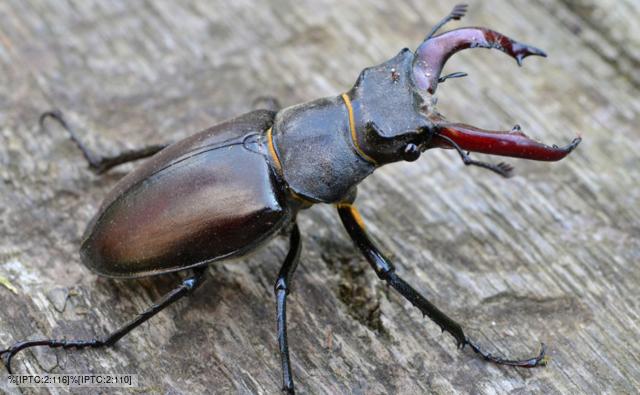
Lucanus cervus

Stag beetles are a species which contain approximately one thousand two hundred different kinds of beetles. These beetles fall under the family known as Lucanidae. Lucanus cervus is one of the best-known species of stag beetles in the West and thus, in many articles, is often referred to as solely “the stag beetle.” In various regions of the world, such as the United Kingdom, it is found in urban gardens and forests. These beetles love old trees and feed off of dead wood. Female members of this species also use decaying wood as an area to lay their eggs. Unfortunately, because of deforestation and forest management policies which call for eliminating old trees, this species is on the decline and is now listed as a globally threatened species.

The picture above is a typical life cycle of a stag beetle. Stag beetle larvae are blind, have a transparent body and possess a head which is distinct from their pincers. They also possess “combs” in their legs which they use to communicate with other larvae. Fascinatingly, it takes a larvae anywhere from four to six years to become a pupa. They then remain as a pupa in the soil for approximately three months and then become an adult. Unfortunately, adult stag beetles only live between two to three weeks on average.

Stag beetles are sexually dimorphic, which means that females and males display differing phenotypes. As seen in the picture above, male beetles have much larger mandibles as opposed to their female counterparts. It because the male beetle’s mandible, (which resembles the horns of a stag), and how they use their mandible in combat that the stag beetle derives its common name from.
Stag beetles play a huge role in society. Because stag beetles are endangered, many activists and scientists are actively advocating for not ruining their natural habitat. Furthermore, because stag beetles usually reside in trees, because of deforestation, human interaction and being unprotected out in the open has caused them to be endangered. How can we help retain biodiversity here on Earth? If someone is fortunate enough to see this magnificent creature, he or she can record this information on on the Great Stag Hunt page (mainly applies to people in the UK). One can also make log pile habitats in a garden at home so these beetles have an extra area to reside in!
Image #1: http://ichef.bbci.co.uk/naturelibrary/images/ic/credit/640×395/s/st/stag_beetle/stag_beetle_1.jpg
Image #3: http://maria.fremlin.de/stagbeetles/glossary.html
Link #1: http://www.arkive.org/stag-beetle/lucanus-cervus/
Link #2: http://en.wikipedia.org/wiki/Lucanus_cervus
Coccinellidae – Ladybird Beetle
Coccinellidae are a family of beetles belonging to the superfamily Cucujoidea, which belongs to the series Cucujiformia within the suborder Polyphaga. (http://entnemdept.ufl.edu/creatures/beneficial/lady_beetles.htm)
Commonly referred to as the “Lady Bug” or “Ladybird”, Coccinellidae can range in colors from yellow, orange, and scarlet, usually with black spots on their wing covers.
 (photo: various colorings of different species of Coccinellidae)
Coccinellidae exist all over the world, with about 6,000 species described (http://entnemdept.ufl.edu/creatures/beneficial/lady_beetles.htm).
 (photo: Coccinellidae with visible wings beneath hard wing cover)
They often feed on aphids and scale insects, which are viewed of as pests, so certain Coccinellidae are considered welcome in many gardens and agriculture fields. Some larger species of Coccinellidae eat other insects as well as their eggs (http://en.wikipedia.org/wiki/Coccinellidae).
Adult coccinellidae are oval in shape and can range from 1mm to 10mm in length and females are often larger than males. They use their mandibles for chewing and have tibio-femoral articulations that they can reflex bleed from. Their blood/hemolymph is used as a repellent because it smells terrible and contains certain alkaloid toxins (http://entnemdept.ufl.edu/creatures/beneficial/lady_beetles.htm)
 (photo: Asian Ladybird Beetle laying eggs on underside of a leaf)
Coccinellidae eggs produce larvae that undergo four stages before pupating, metamorphosing, and turning into adults. Their larvae are very different looking than full grown adults. They have soft bodies and are flat and elongated before they turn into the hard shelled adults (http://bugguide.net/node/view/179). (photo: Coccinellidae larva)
photo 1: https://naturefiles.files.wordpress.com/2010/12/760px-harmonia_axyridis01.jpg
photo 2: http://nakkimo.deviantart.com/art/Coccinellidae-321295207
photo 3: http://bugguide.net/node/view/319713
photo 4: http://bugguide.net/node/view/158697
Cerambycidae – Long horned Beetles
The Cerambycidae family describes beetles that belong to the Order of Coleoptera, Suborder Polyphaga, which includes water, rove, scarab, long horned, leaf, and snout beetles, superfamily Chrysomeloidea, which classify long horned and leaf beetles, and ultimately the Cerambycidae family, specifically long-horned beetles.


Possessing some of the largest beetles in the order, long horned beetles are well known for their long antennae, or horns, and wood-boring larvae. Their horns are often as long, if not longer, than the entire body of the beetle. Of around 20,000 species worldwide, about 1200 exist in North America. Worldwide, their range of living spans from sea level to around 4200 meters above sea level.
Possessing a long, cylindrical body, adult long horned beetles usually measure about 0.33 to 2.0 inches long. Like stated before, this family possesses some of the largest beetles species in existence, for example, the titan beetle can get up to 16.7 cm long (or 6.5 inches!). Males tend to possess longer antennae amongst species. Long-horned beetles vary in color across the entire visible spectrum, ranging from dark, dull browns to vibrant, intricate patterns across their backs/wing covers. Their feeding habits also fluctuate across species, spanning from eating flowers, leafs, blossoms, sap, bark, and fungi.

The life cycle of the long horned beetle depends on the geographical location, ranging from about 1-3 years but dropping even lower in certain cases. Female long horned beetles usually lay their eggs in dead or decaying wood, which the larvae immediately begin feeding on/boring into after hatching. As a result, long horned beetles are often seen as pests, since their larvae effectively destroy the deep-rooted structures of trees, potentially killing them. By extension, some of these trees get harvested for their lumber for furniture, and their influence causes great weaknesses within the wood. These larvae are a pale, white color that looks quite wormlike.


Link 1: http://bugguide.net/node/view/171
Link 2: http://www.everythingabout.net/articles/biology/animals/arthropods/insects/beetles/longhorned_beetle/
Pic 1: http://asian-longhorned-beetle.com
Pic 2: http://www.arkive.org/titan-beetle/titanus-giganteus/
Pic 3: http://www.nhc.ed.ac.uk/index.php?page=25.130
Pic 4: http://www.nhc.ed.ac.uk/index.php?page=25.130
Pic 5: http://www.ndinvasives.org/copy_of_asian-longhorn-beetle/asian-longhornd-beetle-life-cycle
Dynastinae — Rhinoceroses beetles
Beetles are a pretty common idea to most of us, and rightly so — beetles constitute the largest species group out of any other group of organisms. However, the types and species of beetles that many of us our accustomed to in many of our own lives is probably limited. When we think of beetle, we might think of common everyday ones that we may see in urban California, like the common black ground beetle, an important soil decomposing beetle that can be found in the gardens of many homes. However, many of us probably wouldn’t pop the image of a Rhinoceros Beetle, a beetle that, unlike here, is actually prevalent and even so far as a culturally popular icon in many other countries in some parts of the world.

(Picture of Rhinoceros Beetles fighting)
Rhinoceros Beetles, or Dynastinae, are the largest of of all beetles in length, reaching up to 150 mm (6 in) in length. Yet, despite their size and appearance Rhinoceros Beetles are completely harmless and are on flip side very human friendly — because they cannot bite or sting. Geographically, they are native to many parts of the world, with different types of Rhinoceros Beetles prevalent in different areas. For example, the Hercules Beetle (pictured below), which (along with other Rhinoceros Beetles) is known for its incredible strength, is native to South America and Central America, while the Japanese Rhinoceros Beetle is indigenous to Japan and other parts of Asia. Characteristic wise, Rhinoceros beetles are probably most known for their large horn like projections that are found around the heads of male Rhinoceros beetles. It is precisely from these characteristic horns that they derive their specie’s name (horns like a Rhinoceros). The Hercules Beetle and the Atlas Beetle are popular and famous examples of the Rhinoceros Beetle today.
(Pictured Below, Hercules Beetle)

For its life cycle, the Rhinoceros Beetle, which is most often seen in its adult and “grown-up” form, actually lives a majority of its life underground, where it feeds on decaying matter and holds an important environmental impact. In this stage of its life cycle Beetles are found as larvae and contribute as key decomposers in ecosystems. For duration, the time spent between larvae and adult life cycles depends among species of Rhinoceros Beetles, but generally after around one and a half years, Rhinoceros Beetles will emerge from the ground in their adult form, where they will function as herbivores and feed on items like fruit, nectar, and sap. In their adult form, Rhinoceros Beetles will shed and molt their skin several times before they reach their full size.

(Life cycle of Rhinoceros Beetle pictured above)
Culturally, Rhinoceros Beetles are prevalent in many countries around the world, especially in Asia, where Rhinoceros Beetles are kept as pets and are featured in literature, manga, manhwa, anime, dramas, video games, gambling and in various other forms of media and entertainment. In Japan for example, Japanese Rhinoceros Beetles, which are known as “Kabutomushi”, meaning “insect holding a helmet”, are especially popular with kids, and can be found in or around the local areas in many of the habitats found in Japan. Not to mention, Rhinoceros Beetles are completely safe and harmless, making them the perfect pet.

(Picture of Japanese Beetle Game, MushiKing [King of Beetles])
Link1: http://www.nwf.org/wildlife/wildlife-library/invertebrates/rhinoceros-beetles.aspx
Link2: http://www.animalcorner.co.uk/insects/beetles/beetle_rhino.html
Pic1: http://www.thaiguidetothailand.com/wp-content/gallery/fauna/kwang-5.jpg
Pic2: http://wallpapers111.com/wp-content/uploads/2015/01/Hercules-Beetle-Wallpaper-7.jpg
Pic3: http://t1.ftcdn.net/jpg/00/53/58/06/400_F_53580612_MOfNKzi7Egb5KPVFiebhHKv9wgUgZTFm.jpg
Pic4: http://ww1.prweb.com/prfiles/2005/07/13/261460/CollectingCards.jpg
 As a characteristic of being the largest group of insects, many types of Beetles are understandably incredibly diverse in their functions and roles — performing crucial and unique roles for their environment separate from their standard service as a food for many organisms in the food chain. One such example of a beetle is the dung beetle, which was discovered to feed and reproduce in the dung of herbivores, and inadvertently are responsible for removing millions of tons of dung. Left intact, the dung would otherwise most likely destroy acres of valuable pastureland and other natural areas.


 Basic Internal Anatomy of a beetle